Key Takeaways (Executive Summary)
- Reconstitution is the process of restoring a lyophilized peptide powder into a homogeneous liquid solution using sterile Bacteriostatic Water.
- Powder form peptides in unopened vials do NOT strictly require refrigeration during short-term shipping, but must be stored below 4°C or at -20°C for long-term multi-year stability.
- Always direct the stream of diluent down the inside glass wall of the vial; never spray liquid forcefully directly onto the lyophilized cake.
- Never shake a peptide vial; gently roll between your palms until the solution becomes completely transparent.
How to Reconstitute Peptides: The Definitive Protocol for Accurate Laboratory Dosing
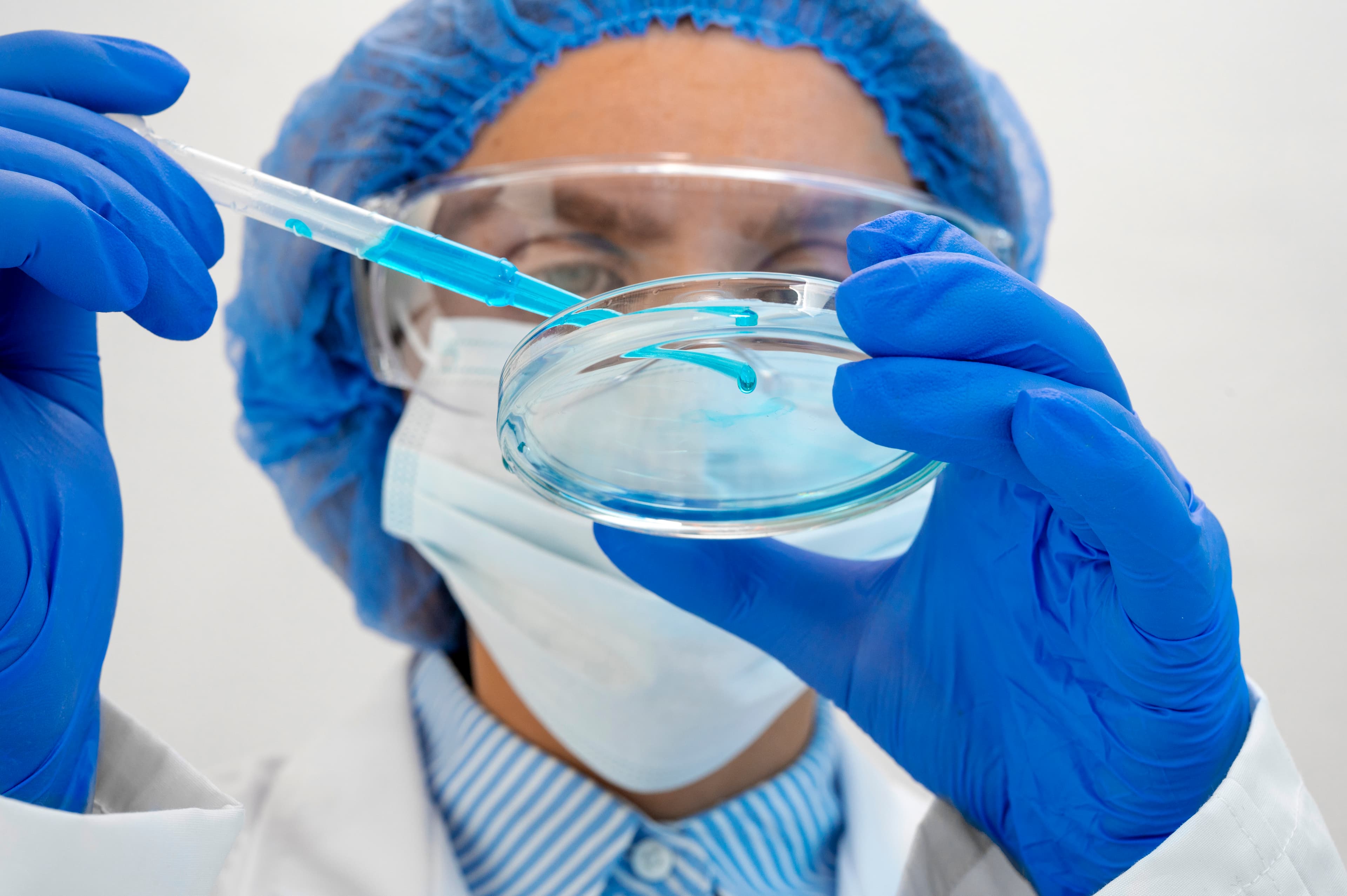
Learning how to reconstitute peptides is the single most essential skill in peptide research. Because synthesized peptides are fragile macromolecules sensitive to heat and enzymatic hydrolysis, manufacturers freeze-dry them into a solid lyophilized state (powder cake).
Before any laboratory assay, this powder must be dissolved with a sterile, preserved diluent. In this guide, we cover the exact step-by-step reconstitution protocol, mathematical concentration formulas, and proper temperature management.
Do Powder Form Peptides Need to Be Refrigerated Before Reconstitution?
A common question is: do powder form peptides need to be refrigerated before reconstitution?
- During Transit (1 to 2 Weeks): Intact, vacuum-sealed lyophilized vials remain stable at standard room temperature (15–25°C) without measurable degradation.
- Short-Term Storage (1 to 6 Months): Store in a dry, dark refrigerator at 2°C to 8°C.
- Long-Term Preservation (1 to 3+ Years): Store in a standard laboratory freezer at -20°C protected from moisture and light.
- After Reconstitution: The liquid solution MUST always be refrigerated at 2°C to 8°C and used within 28 to 30 days.
5-Step Reconstitution Protocol
Step 1: Preparation & Disinfection 1. Clean your laboratory workspace with 70% isopropyl alcohol. 2. Pop off the plastic flip-top cap of the peptide vial and the [Bacteriostatic Water](/product/bacteriostatic-water-30ml) vial. 3. Swab the rubber stoppers of both vials thoroughly with an alcohol prep pad and allow them to air-dry for 10 seconds.
Step 2: Drawing the Sterile Diluent Using a sterile mixing syringe from your [Advanced Reconstitution Kit](/product/advanced-reconstitution-kit), draw your intended volume of Bacteriostatic Water (e.g., 2.0 ml for a standard 5mg vial).
Step 3: Gentle Liquid Transfer Insert the needle through the center of the peptide vial's rubber stopper at a 45-degree angle. Because the vial is vacuum-sealed, the liquid will naturally pull into the vial. **Slow down the plunger** to let the water trickle down the inside glass wall.
Step 4: Gentle Dissolution Never shake the vial vigorously, as turbulent agitation can shear delicate tertiary peptide peptide chains. Gently swirl or roll the vial between your palms until the powder is fully dissolved and the solution is crystal clear.
Step 5: Cold Storage Label the vial with the date of reconstitution and concentration, and immediately place it into cold storage (2–8°C).
Quick Dilution Reference Chart (U-100 Syringe, 100 Units = 1.0 ml)
| Peptide Mass in Vial | Bacteriostatic Water Added | Resulting Concentration | 250 mcg Research Dose | 500 mcg Research Dose |
|---|---|---|---|---|
| 5 mg (BPC-157 / TB-500) | 2.0 ml | 2.5 mg/ml (2500 mcg/ml) | 10 Units (IU) | 20 Units (IU) |
| 5 mg | 1.0 ml | 5.0 mg/ml (5000 mcg/ml) | 5 Units (IU) | 10 Units (IU) |
| 10 mg (Semax / Selank) | 2.0 ml | 5.0 mg/ml (5000 mcg/ml) | 5 Units (IU) | 10 Units (IU) |
| 50 mg (GHK-Cu Complex) | 5.0 ml | 10.0 mg/ml (10000 mcg/ml) | 2.5 Units (IU) | 5 Units (IU) |
Essential Supplies for Precision Reconstitution
- Advanced Reconstitution Kit: Complete set with sterile diluents, large mixing syringes, and alcohol prep swabs.
- Bacteriostatic Water 30ml: High-grade sterile water with 0.9% benzyl alcohol preservative.
- Precision Micro-Syringe Kit: Calibrated U-100 micro-syringes for exact unit measurement.
- Digital Micro Milligram Scale: Ultra-precise laboratory measurement.
Third-party verified via HPLC & Mass Spectrometry with batch-specific CoA.
Why should I use bacteriostatic water instead of sterile water?
Sterile water (saline or plain sterile water) contains no antibacterial preservative and must be discarded within 24 hours of opening. Bacteriostatic water contains 0.9% benzyl alcohol, which prevents bacterial growth for up to 28–30 days.
What happens if I shake a reconstituted peptide vial?
Vigorous shaking can break fragile peptide bonds and denature complex secondary or tertiary amino acid structures, reducing the biological potency of the compound.
How do I know if my reconstituted peptide has degraded?
If the reconstituted solution becomes cloudy, precipitates visible floaters or flakes, or changes color (other than naturally colored peptides like GHK-Cu which is blue), it should be safely discarded.